
UPI Is Changing: ₹2,000+ Payments Raise New Concerns for Merchants
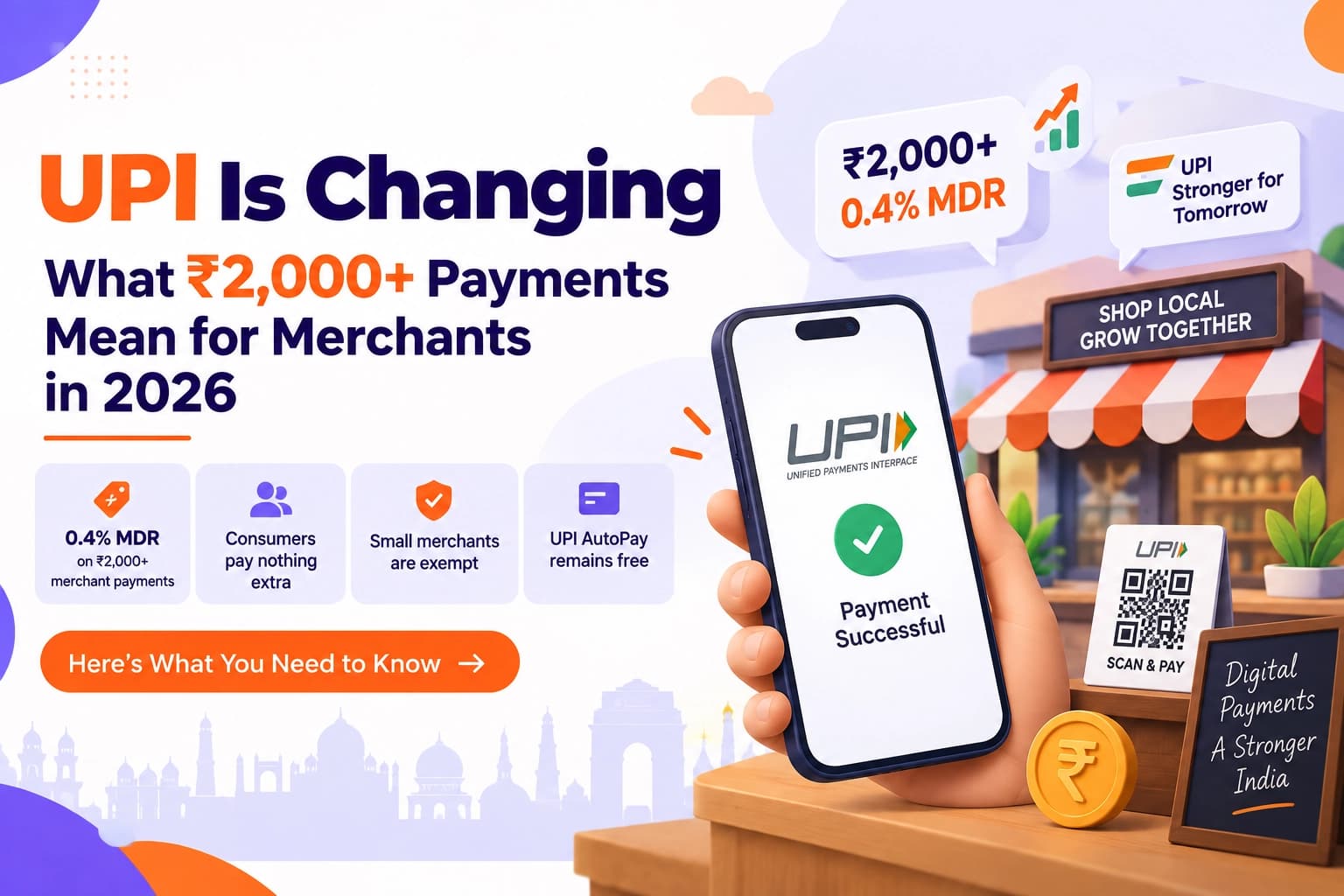
Starting October 15, 2026, eligible UPI payments made at merchants above ₹2,000 will carry a 0.4% Merchant Discount Rate (MDR). Consumers pay nothing extra — but the change has shaken small retailers, kirana owners, and online sellers who have depended on zero-cost UPI acceptance since 2020. Here is a plain-language breakdown of what changed, who it actually affects, and what you should do before the deadline.
Table of Contents
What Is MDR, and Why Is It Coming Back to UPI?
MDR — Merchant Discount Rate — is the fee a payment ecosystem charges to process a transaction. Banks, payment aggregators, and app providers share it. In India, MDR on UPI was effectively zeroed out in January 2020 through a government mandate, with a subsidy covering the gap. That zero-MDR window is now partially closing.
On September 14, 2026, the Finance Ministry's Department of Financial Services issued Gazette Notification S.O. 5067(E) under Section 10A of the Payment and Settlement Systems Act, 2007. It formally protects UPI transactions up to ₹2,000 from any charge — and that explicit cap opened the door for NPCI to announce MDR on larger transactions.
NPCI's stated reason is sustainability. Over the last decade, UPI grew from 1.78 crore transactions in FY2016–17 to over 24,000 crore in FY2025–26. That volume requires banks, acquiring processors, and app platforms to invest continuously in infrastructure, fraud prevention, and server capacity — all without a revenue model. MDR is meant to fix that.
Who Pays, Who Does Not?
This is where most of the confusion sits. The short answer: merchants pay, consumers do not.
Under the revised framework:
Consumers making a UPI payment of any amount pay zero additional fee. Nothing changes when you scan a QR code.
Person-to-Person (P2P) transfers — sending money to a friend, family member, or splitting a bill — remain completely free regardless of the amount.
Merchant payments up to ₹2,000 remain outside the MDR structure.
Small merchants processing under ₹1 lakh per month via UPI QR are protected and exempt.
Eligible P2M transactions above ₹2,000 at larger, specified merchants attract 0.4% MDR, borne within the payment ecosystem.
The government has explicitly said merchants cannot surcharge customers for this cost. But the real concern — and it is a legitimate one — is that some merchants will pass it on indirectly, either by adding small charges on digital payments or by steering customers back toward cash for higher-value bills.
The Numbers: How Much Does 0.4% Actually Cost a Merchant?
The MDR is simple arithmetic, but worth spelling out for businesses doing their planning:
| Transaction Value | MDR at 0.4% |
|---|---|
| ₹2,500 | ₹10 |
| ₹5,000 | ₹20 |
| ₹10,000 | ₹40 |
| ₹25,000 | ₹100 |
| ₹50,000 | ₹200 |
| ₹75,000 and above | ₹300 (capped) |
For transactions of ₹75,000 or more, the MDR does not keep climbing — it is capped at ₹300. So the maximum a merchant pays on a single eligible UPI transaction is ₹300, regardless of whether the payment is ₹75,000 or ₹5 lakh.
For a kirana or mid-size retailer doing ₹1 lakh in eligible UPI sales per month above the ₹2,000 threshold, the monthly MDR cost works out to ₹400. That sounds modest in isolation. But for a shop running on 5–8% margins, ₹400 per lakh is a real line item — and the Retailers Association of India (RAI) has already flagged that this timing, just ahead of the festive season, puts additional pressure on businesses that count on high-volume October and November sales.
Which Sectors Get Different MDR Rates?
Not all merchant categories fall under the flat 0.4%. NPCI has set specific structures for certain sectors:
Essential and Public Services
Railways, telecom services, insurance premiums, and fuel attract a flat ₹5 per transaction — not a percentage. This keeps everyday essential payments extremely low-cost for merchants in those categories.
Capital Markets
UPI payments toward mutual funds, securities, stockbrokers, and dealers carry an MDR of 0.02%, capped at ₹300 per transaction. If you're running an investment platform and your users pay via UPI, this is the rate that applies. If you shop on platforms like Amazon or Flipkart and redeem cashback or invest via those apps, transactions classified under capital markets follow this lower structure.
UPI AutoPay
Recurring payment mandates — SIPs, subscriptions, EMIs set up via UPI AutoPay — are exempt from MDR entirely. These remain free.
Small merchants (under ₹1 lakh/month via UPI QR)
Exempt. The policy is deliberately targeted at larger commercial entities, not the neighbourhood tea stall or vegetable vendor.
Why Small Retailers Are Worried Anyway
The math above might suggest small shops have nothing to worry about. But several practical concerns have emerged since the notification.
First, merchant classification is not always straightforward. A mid-size electronics shop, a large grocery chain, or an apparel retailer with significant monthly volumes may fall into the "eligible" category even if their per-transaction amounts are modest. Business owners need to check with their payment service provider how they are classified before October 15.
Second, there is a secondary effect on supply chains. When a retailer orders inventory from a distributor via UPI for amounts above ₹2,000 — which is routine in B2B trade — that transaction may attract MDR too. The cost accumulates across the chain.
Third, and most visibly: some merchants are already putting up notices at their counters, asking customers to pay in cash for amounts above ₹2,000. A photograph of such a sign at a grocery store in Delhi went viral in mid-September 2026, sparking the broader debate about whether UPI's run as a frictionless payment system is ending.
For shoppers who rely on UPI while buying clothing on Myntra, booking movie tickets on BookMyShow, or paying for groceries via Blinkit or Zepto, the direct consumer experience should not change — these platforms absorb processing costs within their business models. It is offline retail and mid-size physical merchants where friction is most likely to appear.
The RuPay Connection
The same gazette notification that triggered the UPI discussion also explicitly protects RuPay debit card transactions from any direct or indirect charge on the person making the payment. This matters because RuPay credit cards linked to UPI follow a different rate structure under existing card MDR rules — not the new 0.4% UPI framework. If you're linking a RuPay credit card to GPay or PhonePe, the applicable MDR is the card network's rate, not UPI's.
What Should Merchants Do Before October 15?
The deadline is close, and the practical steps are not complicated but they do need to happen:
Call your acquiring bank or payment aggregator and ask whether you fall under the eligible P2M category for the new MDR. Small merchants processing under ₹1 lakh per month via UPI QR may find they are exempt and have no action required.
MDR is a deductible business expense. For GST-registered merchants, the 18% GST on MDR is creditable as input tax — meaning you can set it off against your GST liability. A ₹40 MDR on a ₹10,000 transaction carries ₹7.20 GST, which is recoverable. Factor this into your pricing and bookkeeping before the month turns.
The framework explicitly prohibits passing MDR directly onto customers as a separate line item. Restructure pricing if needed, but a visible "digital payment surcharge" on bills is not permitted.
If your supply-side purchases above ₹2,000 happen via UPI, discuss with your distributor whether they plan to move those transactions to NEFT, RTGS, or another channel to avoid the MDR on B2B payments.
NPCI has a track record of revising frameworks after implementation. The ₹1 lakh small-merchant threshold and the caps on essential sectors already show the policy has flexibility built in. Staying informed through your bank or payment provider in October will matter more than acting on today's snapshot.
For consumers, the best practical strategy for now is simple: look for platforms and stores that offer cashback or discount codes to offset any indirect cost increases. Sites like CouponsCrew track the latest offers from major merchants — including JioMart, Nykaa, and Lenskart — so any savings that surface through offers or promotional pricing are easy to find.
Will Consumers Eventually Pay?
The government's current position is unambiguous: UPI stays free for consumers, and there is no plan to introduce consumer-facing UPI fees. Senior officials have publicly said there is "no question" of rolling back the October 15 framework, and that MDR is the mechanism that makes UPI financially self-sustaining for the long run.
That said, the practical reality of merchant economics means that some price adjustments are inevitable. A retailer absorbing ₹400/month in MDR on ₹1 lakh of eligible sales will eventually factor that into operating costs — either through pricing, reduced discounts, or a preference for cash. The impact will be uneven, with digital-native platforms and large retailers better positioned to absorb it than offline mid-size merchants.
The festive season running through October and November 2026 will be the real test. High-value purchases — electronics, appliances, furniture — where UPI payments frequently cross ₹2,000 are the category to watch. If merchants in those segments shift toward encouraging card payments or cash for big-ticket items, the consumer experience of UPI starts to feel different even without a direct fee.
Frequently Asked Questions (FAQ)
Summary & Key Takeaway
The change is real, but it is targeted. For most consumers using UPI daily for groceries, rides, or food orders, October 15 will pass without any visible difference. For merchants — especially those in the middle tier, running retail shops or service businesses with regular high-value transactions — the next few weeks are the time to understand where they stand, update their books, and make sure they are not caught off-guard when the MDR framework kicks in.
Share this Blog
Found this helpful? Share it with your friends and family!
Read More Blogs
Discover more money-saving tips, shopping guides and exclusive deal updates.

Bigg Boss Season 20 (2026): Where to Watch, Price & Best Deals
Bigg Boss 20 is streaming on JioHotstar from September 6, 2026. Here's where to watch, what it costs, confirmed contestants, and the best deals.

10 Best Raksha Bandhan Gift Ideas 2026 — Discount Codes to Save More
Discover thoughtful and trending Raksha Bandhan gift ideas for brothers and sisters, and learn how to stack coupons, bank offers, and cashback to save extra on every gift.